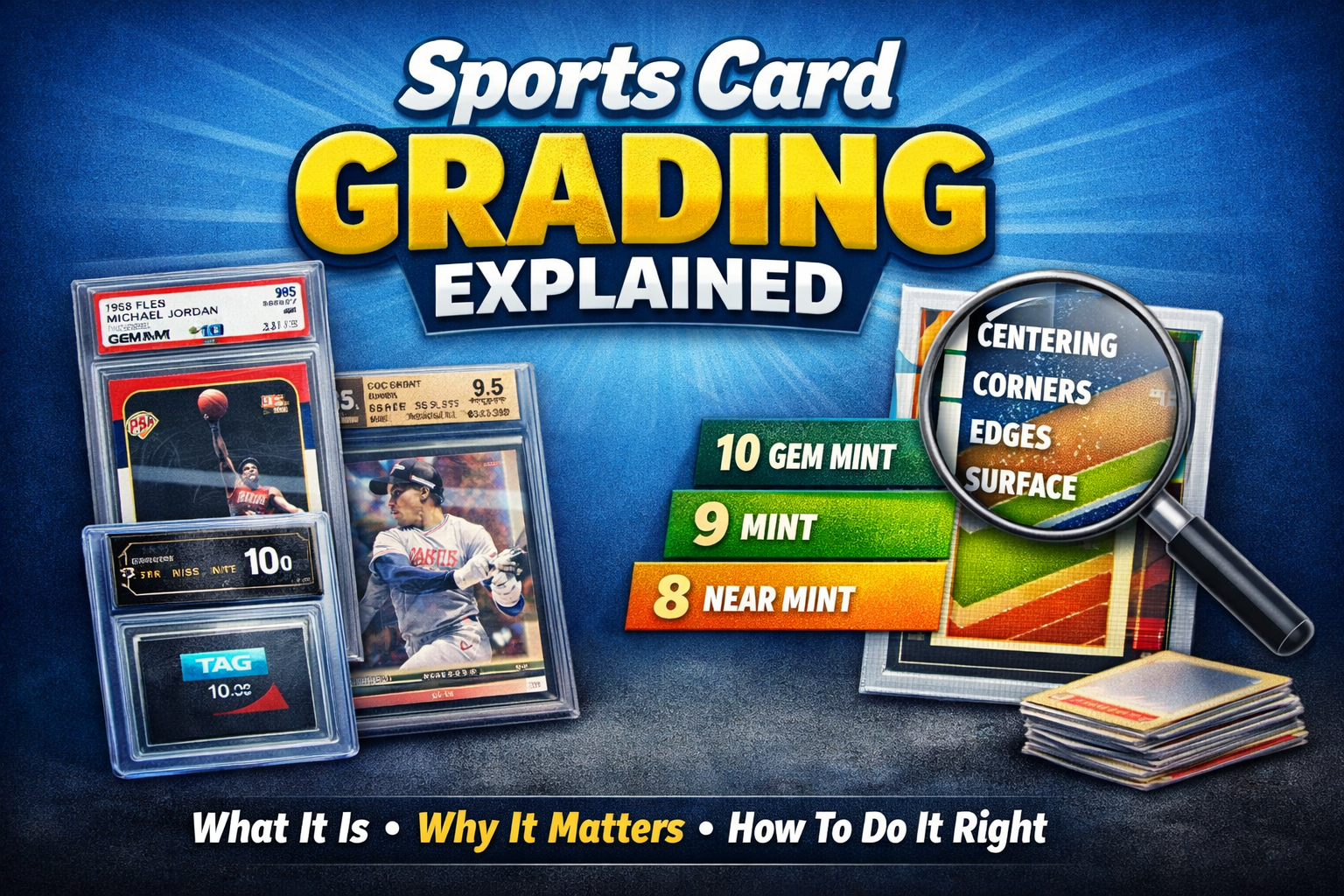
Sports Card Grading Explained: What It Is, Why It Matters, and How to Do It Right
Sports card grading isn’t just some hobby buzzword — it’s one of the biggest value drivers in the entire collectibles world. If you’ve ever wondered why one card sells for $40 raw and $400 slabbed, grading is the reason. Let’s break it down in plain English, no gatekeeping, no fluff.
What Is Sports Card Grading?
Sports card grading is the process of having a third-party company inspect your card, score its condition, and seal it in a tamper-proof case (called a slab). The card is graded on a numerical scale — usually 1 to 10 — with 10 being as close to perfect as it gets.
Once graded, that card now has:
- A verified condition
- A permanent record
- A trusted market value
That combo is why grading matters so much.
How Sports Card Grading Works
Every legitimate grading company looks at the same four core factors:
- Centering – How evenly the image is positioned on the card. Off-center cards lose points fast, especially modern issues.
- Corners – Sharp corners are king. Any whitening, rounding, or fraying hurts the grade.
- Edges – Chipping, rough cuts, or factory flaws along the edges can drop a card a full grade or more.
- Surface – Scratches, print lines, dimples, stains, or gloss issues all live here — and surface flaws are often the silent killers.
Each area contributes to the final grade you see on the slab.
The Sports Card Grading Scale
- 10 (Gem Mint) – Nearly flawless. These command premiums.
- 9 (Mint) – Clean, sharp, very collectible.
- 8 (Near Mint–Mint) – Solid condition, still desirable.
- 7 and below – Playable, vintage-friendly, or collection-only depending on the card.
For modern cards, the real value jump usually happens at PSA 10 vs PSA 9. That single point can mean hundreds — sometimes thousands — of dollars.
Why Sports Card Grading Matters
Here’s the truth: grading isn’t about flexing slabs on Instagram. It’s about trust and liquidity.
Graded cards:
- Sell faster
- Sell for more
- Are easier to comp
- Are safer to ship and store
- For buyers, grading removes doubt. For sellers, it removes negotiation friction. That’s why most serious collectors and investors rely on graded cards.
Popular Sports Card Grading Companies
Not all grading companies are created equal. The market absolutely cares who graded the card.
- PSA – The industry standard. Highest resale value and strongest registry.
- Beckett Grading Services (BGS) – Known for subgrades and thick card expertise.
- TAG – Tech-forward grading with transparency and consistency.
Choosing the right grader depends on the card, the era, and your end goal — flipping, holding, or collecting.
When Should You Grade a Sports Card?
Grade a card when:
- The raw value is already strong
- A higher grade creates a clear price jump
- The card is a key rookie, short print, or low-population issue
- You plan to sell or insure it
Skip grading when:
- The card has obvious damage
- Grading costs outweigh potential upside
- It’s a low-demand base card
Grading isn’t automatic — it’s a strategy.
Common Sports Card Grading Mistakes
A few hard truths:
- Cleaning cards the wrong way can ruin them
- Overestimating condition is expensive
- Submitting everything “just to see” adds up fast
- Ignoring centering on modern cards is a rookie move
Smart grading starts before the submission form ever gets filled out.
Is Sports Card Grading for you?
Sports card grading isn’t magic — it’s leverage. When used correctly, it protects value, unlocks premiums, and gives your collection real market power. When used blindly, it just burns money.
If you want to win in this hobby long-term, you don’t grade more cards — you grade better cards.
Thinking about grading a card but not sure if it’s worth it? What card are you on the fence about right now?
Unable to locate Global Block : 928